
This printable is a counting worksheet. Apples are arranged in groups, and the child’s job is to count each group and write the number, or, in some spots, to match a number to a group. It is meant for children who are solidifying one-to-one counting, usually in pre-K or kindergarten, and it can also be a gentle check for an older child who still rushes and misses one. Print it at letter size from the full-page image in this post, for personal or classroom use, as many times as you need.
Print or download this worksheet (PNG)
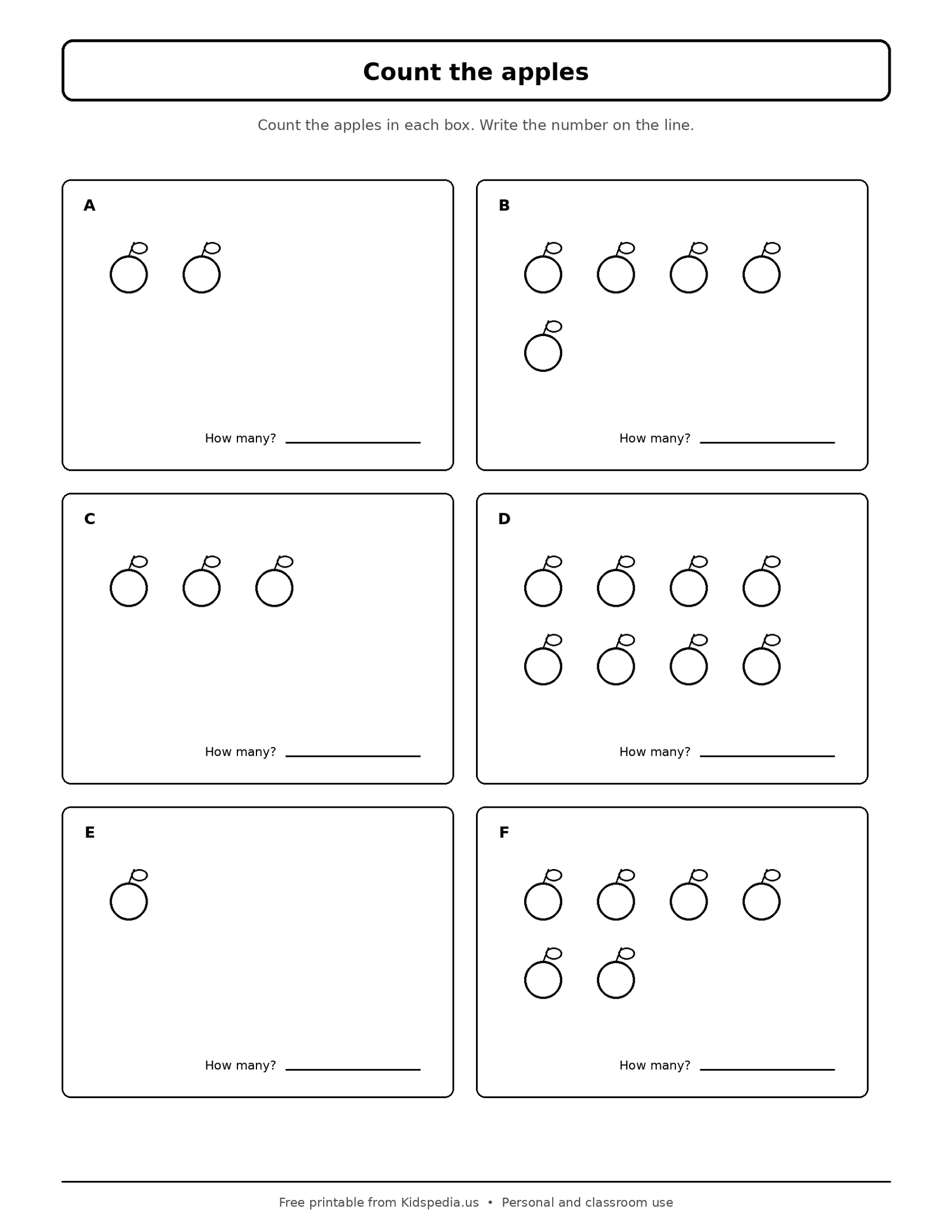
Print on letter-size paper at 100 percent scale. For personal and classroom use.
What is on the page
You will see apple shapes in small sets, some perhaps in a ten-frame or in a row, some in a looser cluster. A looser cluster is harder, because it is easier to count the same apple twice, or to skip one. A row or a frame is easier, because the eye has a path. Both kinds of practice are useful. There will be a place to write the count, a line or a box, and maybe a sample at the top that is already done, which you can look at together before the child starts.
Counting, at this stage, is more than reciting “one, two, three.” It is matching one word to one object, and then knowing that the last word you say is the total. That last part, the cardinality, is a step some children reach later than the reciting. If a child counts six apples, then, when you ask how many there are, starts over, they are still building that idea. You can say, “You counted six, so there are six,” and let that sentence sit, rather than drilling it.
How to count without losing track
Touch each apple, or mark it with a small pencil dot, or a line through it, once it has been counted. A finger alone sometimes slips. A mark is a memory. For a cluster, it can help to start at the top left and move the way we read, or to group in twos, if the child is ready for that. If they get two different answers on two counts, count together, slowly, and see which one you both land on. The second count is not a punishment. It is how careful people count when the first number feels unsure.
Write the numeral after the count, not before, so the writing is a record of what was found, not a guess. If the child knows the number word and not the numeral yet, they can say “seven,” and you can help them find a 7 on a number line, or on the tracing page, and copy it. The worksheet can be a counting lesson first and a writing lesson second, if that is what the child needs that day.
The apples can be colored after the counts are done, or as you go, one group at a time, which makes the page lively and can also mark, in color, which groups are finished.
Printing and using the page again
Print at actual size, in black and white, on letter paper. If the apples are outlined lightly, raise the quality so they stay easy to see and to color. A few extra copies are useful, because counting the same arrangement again, a day later, is fair practice, and because two children may want a page each.
Kidspedia printables are free for personal and classroom use, not for resale. You may print as many as you need. Pair this page with a bowl of real apples, or grapes, or blocks, and count those too, so the worksheet is not the only place numbers appear. A finished page can go on a fridge, or in a math folder, with a note about a group that was tricky. The apples were a picture. The touching, the counting out loud, and the numeral at the end were the work, and they are the same work a child will do with coins, with stairs, and with chairs at a table, long after this sheet is in a folder.
Questions to talk about
- Why does a small mark on each apple, as you count it, help you avoid counting one twice?
- What should you do if you get two different totals for the same group?
- Why is it useful to write the number after you count, rather than guessing the number first?
- Which group of apples was hardest, a neat row or a loose cluster, and why?
- Can you count something in the room the same way, one touch for each object, and say the total at the end?

Read next


 Story break? Play one of 1,458 free kid-safe gamesPlay now →
