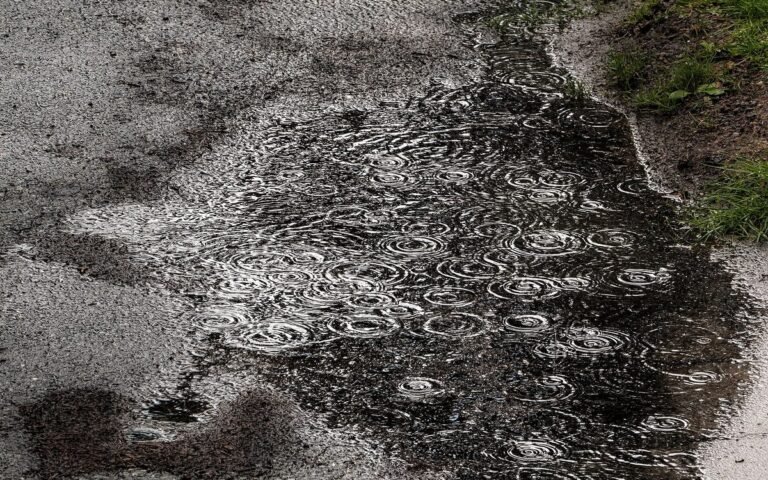
Some days the walk home is ordinary, and some days the sidewalk is full of temporary ponds. This poem is for the second kind of day, when a child has to decide whether to walk around the water or go straight through.
You can read it after a storm, or on a dry afternoon when everyone is wishing for rain. It works aloud, with a small splash of a pause at the end of a few lines.
The Puddle Jumper
The rain has packed its bags and gone,
but left its mirrors on our lawn,
and down the block, in every dip,
a silver puddle curls its lip.
I start with one. I start with two.
My left sock learns what rain can do.
The water blinks. It isn’t deep.
It only wants my feet to leap.
A yellow leaf goes sailing by,
a boat with no one sitting dry.
I send a wave. It tips. It spins
and bumps the curb, and starts again.
Mom says the long way keeps us neat.
The long way misses half the street.
The short way has a puddle lake
that hums each time the branches shake.
I count to three. I hold my breath,
then jump an inch from certain death
(the death of staying clean and tall).
The puddle answers with a wall
of cold that climbs my knees and then
comes laughing down my shins again.
My shoes are two dark, happy ships.
A drop of rain is on my lips.
The sky is tearing into blue.
The robins start their talking too.
I jump the last one, wide and brown,
and wear the weather back to town.
About this poem
The child in the poem is on the way home after a rain, looking at puddles the way some people look at a playground. The “silver puddle” and the leaf-boat are small enough to notice on a real street. The “certain death” line is a joke about staying tidy, not a real scare.
There is a grown-up in the background who would rather keep shoes clean. The poem takes the child’s side without turning the grown-up into a villain. A lot of family walks sound like that: one person watching the clock and the laundry, the other person watching the water.
The last line, “wear the weather back to town,” is a way of saying the rain comes home on the child’s clothes. After a good puddle, you do not leave the weather behind. You carry a little of it.
Words to notice
A dip is a low place in the ground or sidewalk, the kind that holds water after a storm.
“Curls its lip” gives the puddle a slightly cheeky face, as if it is daring the jumper.
Shins are the front part of your lower legs, the part that meets the splash when you jump flat-footed.
How to read it aloud
Start at a walking pace for the first stanza, then get a little bouncier once the jumping starts. On “I count to three. I hold my breath,” slow down, as if you might not jump. Then let the splash stanza run a bit faster.
If you have two readers, one person can take the lines about Mom and the long way, and the other can take the jumping. The last two lines sound best in a satisfied, almost tired voice, like someone who has finished a job.
Kids often want to stamp a foot on the splash lines. Once is fun. Twice will soak the poem.
A thing to try
After you read, go look for one puddle, even a small one near a gutter. Ask: what is floating in it? A leaf, a seed, a scrap of paper? Have your child tell or write four lines about that one puddle, starting with “I start with one.”
If you are staying inside, draw a sidewalk with three puddles and give each puddle a face. Are they shy, bold, or sleepy? The poem treats puddles as if they want company. A drawing can do the same thing.
Questions kids ask
Why does the puddle curl its lip? That is a pretend face. Water can look as if it has an edge or a smile when the wind moves it.
Is the child in trouble at the end? The poem does not say. The shoes are wet and the jumper seems glad. What happens at the door is a later story.
Do I have to jump in puddles to like this poem? No. You can be a person who walks around them and still enjoy the splash on the page.

Read next


 Story break? Play one of 1,458 free kid-safe gamesPlay now →