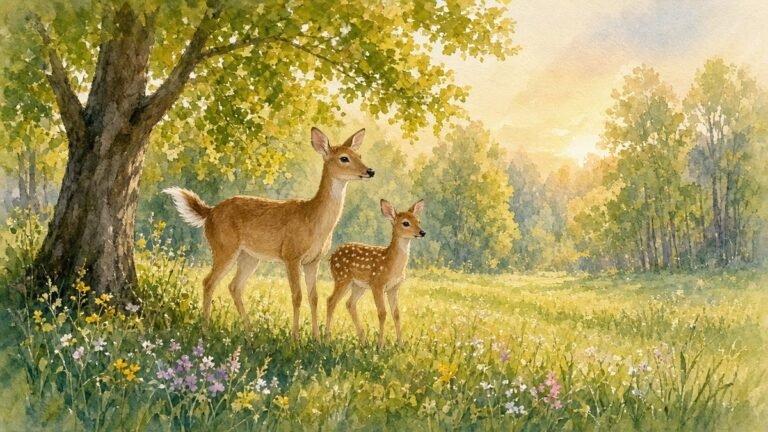
A white-tailed deer is the wild animal many American kids are most likely to see close to home. Deer live in forests, farm country and even suburban yards. At dusk they may step out of the trees to nibble grass or garden plants. When they run, a white flag of a tail goes up, which is how they got their name. Here are white-tailed deer facts for kids.
White-tailed deer facts at a glance
- Range: much of the United States, plus parts of Canada, Mexico and Central America
- Baby name: a fawn
- Female: a doe
- Male: a buck
- Food: leaves, twigs, acorns, fruit, grass and sometimes crops or garden plants
- They are mammals and ruminants, so they chew cud, a bit like cows
- The tail is brown on top and white underneath
Why the tail flashes white
When a deer is alarmed, it often lifts its tail and bounds away. The white underside flashes like a signal. Other deer can see that flash and follow or take cover. The tail is one of the easiest field marks, along with the tan or gray-brown coat and the long legs.
Deer see well in low light and have their eyes on the sides of the head, which helps them watch for danger while they eat. They also have a strong sense of smell and hearing. That is why a loud voice or a sudden movement will usually send a yard deer back into the trees.
Fawns and the “leave it alone” rule
A doe is pregnant for about six to seven months and often has one fawn or twins in spring. A newborn fawn has white spots that help it disappear in dappled light. For the first days and weeks, the mother may leave the fawn lying in grass or at the edge of a woods while she feeds. The fawn stays very still. This is normal.
People sometimes think a quiet fawn has been abandoned. In most cases the mother is nearby and will come back. The kind thing is to leave the fawn where it is, keep dogs away and tell a grown-up. Only a wildlife official or a rehabilitator should decide if a fawn needs help.
As the fawn grows, the spots fade. By late summer it looks more like a small adult.
Antlers, grown and shed
Bucks grow antlers, which are made of bone. In spring and summer the growing antlers are covered with a soft, fuzzy skin called velvet, which carries blood to the bone. Later the velvet is shed, and the antlers harden. In the fall, during the mating season called the rut, bucks use their antlers in pushing matches with other males.
After that season, the antlers fall off. Then the buck grows a new set the next year. The size and shape can change as the deer gets older and depending on food and health. Does do not usually grow antlers.
Where deer live in the United States
White-tailed deer are found in most of the lower 48 states and in parts of the North. They do well in a mix of woods and open land, which is one reason they have also settled into suburbs. A park, a golf course edge or a greenway can be enough cover, especially at dawn and dusk, when deer prefer to move and feed.
Because deer are so common, they are an important part of local ecosystems. They eat plants, and other animals may feed on deer that die naturally. In some places there are so many deer that they eat too many young trees and garden plants. Wildlife officers in each state keep an eye on the herds.
Deer also cross roads. If you are in a car in deer country, a grown-up should drive with extra care at dusk, especially in fall.
Watching deer the kind way
Enjoy them from a window or from a distance. Do not feed them. Human food is not a healthy diet, and feeding can make deer bolder around cars and people. Do not try to pet a deer or pick up a fawn. In tick season, a grown-up may also remind you to check for ticks after a walk in tall grass or woods, because ticks live in some of the same places deer do.
For a report, include the white tail, the spotted fawn and the fact that antlers are grown and shed each year. Then add one safety rule: if you find a quiet fawn, leave it alone and tell a grown-up. That is a complete, useful page about one of America’s most familiar wild animals.

Read next


 Story break? Play one of 1,458 free kid-safe gamesPlay now →
