More animal facts for kids
What makes a bird a bird?
Birds are the only animals with feathers. Most birds also have wings, lay eggs with hard shells and have beaks instead of teeth. Plenty of birds fly, but flight is not required. Penguins swim with their wings. Ostriches run. Chickens flap and flutter, then usually stay close to the ground.
There are about 10,000 kinds of birds on Earth. Some, like hummingbirds, can weigh less than a nickel. Others, like the ostrich, can be taller than a grown-up.
How birds live
Birds eat many kinds of food, and their beaks are clues. A cardinal has a thick, short beak for cracking seeds. An eagle has a hooked beak for tearing meat. A hummingbird has a long, thin beak for sipping nectar. Owls swallow small prey and later cough up a pellet of bones and fur.
Many birds build nests and sit on their eggs to keep them warm. After the chicks hatch, the parents often bring food until the young birds can fly. That first flight is called fledging.
Birds also sing and call to find a mate, warn of danger or mark a territory. A robin's song in spring is a familiar sound in many American yards.
Birds you will meet on these pages
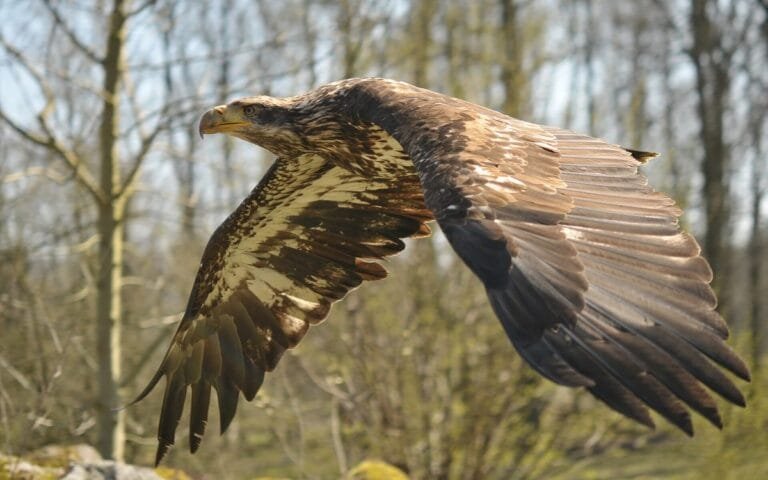
The bald eagle is the national bird of the United States. It is a bird of prey, which means it hunts other animals, especially fish.
Owls are mostly night hunters. Their quiet feathers and sharp hearing help them find mice in the dark.
Hummingbirds can hover in midair and beat their wings dozens of times in one second. In the U.S., the ruby-throated hummingbird is a common summer visitor in the East.
Penguins are birds of the Southern Hemisphere. They "fly" underwater and often live in very cold places.
Chickens are birds people raise on farms for eggs and, on some farms, for meat. A chick hatches in about 21 days.
Backyard birds in the United States
You do not need a jungle to study birds. A feeder or a quiet walk can turn up northern cardinals, blue jays, American robins, mourning doves, chickadees and crows. Cardinals stay red all winter in many states, which makes them easy to spot against snow. Blue jays are loud, bright and clever. If you add a birdbath and native plants, more birds may visit your yard.
Binoculars help, and so does a simple notebook. Write the date, the color of the bird and what it was doing. Over time you will start to notice who shows up in which season.
Birdwatching tips for kids
- Move slowly and keep your voice low.
- Look at size, color, beak shape and where the bird is: in a tree, on a lawn or at the water.
- Never touch a nest or a baby bird unless a wildlife expert or a grown-up says you should.
- Keep cats indoors if you want to protect wild birds.
- In the United States, most wild birds and their eggs and nests are protected by law, so look, enjoy and leave them be.
Teachers can pair these pages with a spring nature walk or a lesson on life cycles, since a chicken egg is one of the easiest bird life cycles to study up close.
Questions grown-ups ask
Do all birds fly?
No. Penguins, ostriches, emus and kiwis cannot fly. Their bodies are built for swimming or running instead.
What is the national bird of the United States?
The bald eagle is the national bird of the United States. You can also find it on the Great Seal and on some coins.
Why do birds have feathers?
Feathers help birds fly, stay warm and stay dry. They also give birds their colors, which can help with hiding or finding a mate.
What birds might I see in my backyard?
Depending on your state, you might see robins, cardinals, blue jays, doves, sparrows, chickadees, crows or hummingbirds.
What should I do if I find a baby bird?
If it has few feathers and is on the ground, call a grown-up. If it is a fledgling with feathers, hopping and being watched by a parent, it is often best to leave it alone.