Dinosaurs lived on Earth for about 165 million years, far longer than people have been around. We know about them from fossils: bones, teeth, footprints and even eggs turned to stone. Here are the facts kids love most about these amazing animals.
Quick dinosaur facts
- First dinosaurs: about 230 million years ago
- Last non-bird dinosaurs: about 66 million years ago
- Number of known species: more than 1,000, with new ones found every year
- Biggest: long-necked sauropods like Argentinosaurus, about 100 to 120 feet long
- Smallest: some were the size of a crow or a chicken
- Closest living relatives: birds
When did dinosaurs live?
Scientists divide the age of dinosaurs into three periods. Together they are called the Mesozoic Era.
The Triassic Period (252 to 201 million years ago)
The first dinosaurs appeared. They were small, fast and walked on two legs. All the land on Earth was joined in one giant supercontinent called Pangaea.
The Jurassic Period (201 to 145 million years ago)
Giant long-necked dinosaurs like Brachiosaurus and Diplodocus roamed the land. Stegosaurus and Allosaurus lived during this time. Pangaea began to break apart.
The Cretaceous Period (145 to 66 million years ago)
Tyrannosaurus rex, Triceratops and Velociraptor lived during this period. The first flowering plants appeared.
Here’s a surprising fact: T. rex lived closer in time to us than to Stegosaurus. About 80 million years separated Stegosaurus and T. rex. Only about 66 million years separate T. rex and us.
Famous dinosaurs
Tyrannosaurus rex
- Name means: “tyrant lizard king”
- Length: about 40 feet
- Weight: about 9 tons
- Diet: meat
T. rex had a huge head and about 60 teeth, some as long as bananas. Its bite was one of the strongest of any land animal ever. Its arms were tiny, about 3 feet long, but very strong. Many T. rex fossils have been found in Montana, South Dakota and Wyoming. “Sue,” one of the most complete T. rex skeletons, is at the Field Museum in Chicago.
Triceratops
- Name means: “three-horned face”
- Length: about 30 feet
- Diet: plants
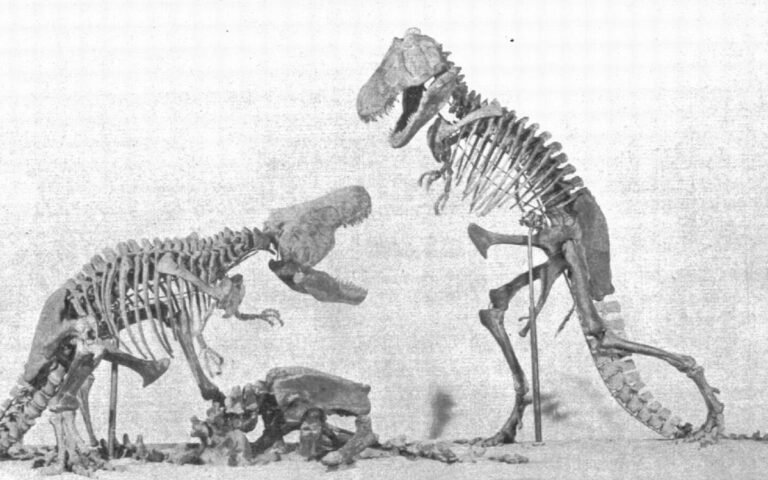
Triceratops had two long horns above its eyes, a short horn on its nose and a big bony frill around its neck. It lived at the same time and place as T. rex, and fossils show that they fought. Triceratops is the state dinosaur of Wyoming and the state fossil of South Dakota.
Stegosaurus
- Name means: “roof lizard”
- Length: about 30 feet
- Diet: plants
Stegosaurus had two rows of tall plates on its back and four spikes on its tail. Its brain was tiny, about the size of a lime. Stegosaurus is the state fossil of Colorado.
Brachiosaurus
- Name means: “arm lizard”
- Height: about 40 to 50 feet
- Diet: plants
Its front legs were longer than its back legs, so it stood tall like a giraffe and could eat leaves from the tops of trees.
Velociraptor
- Name means: “swift thief”
- Length: about 6 feet
- Diet: meat
In movies, Velociraptors are shown as big as people. Real ones were about the size of a turkey, and they had feathers.
Were dinosaurs covered in feathers?
Many were. Scientists have found fossils with feathers, especially in China. Many meat-eating dinosaurs, like Velociraptor, had feathers. Even young T. rexes may have had fuzzy, feather-like coats. Not every dinosaur had feathers, though. Some, like the big plant eaters, had scaly skin.
Dinosaurs and birds
Birds are living dinosaurs. They evolved from small, feathered meat-eating dinosaurs about 150 million years ago. That means the robin in your backyard and the chicken on a farm are related to T. rex.
What happened to the dinosaurs?
About 66 million years ago, a giant asteroid about 6 miles wide crashed into Earth near what is now the Yucatan Peninsula in Mexico. It made a crater more than 100 miles wide, called Chicxulub.
The crash caused fires, giant waves and clouds of dust that blocked the sun for months or years. Plants died, and then the animals that ate them died. About three quarters of all species on Earth disappeared, including all dinosaurs except the ones that became birds.
Huge volcanic eruptions in India around the same time probably made things even worse.
Pterosaurs and sea reptiles are not dinosaurs
Flying reptiles like Pteranodon and swimming reptiles like Mosasaurus and Plesiosaurus lived at the same time as dinosaurs, but they were not dinosaurs. Dinosaurs lived on land and had legs tucked under their bodies, like a horse.
Dinosaurs in the United States
The United States is one of the best places in the world to find dinosaur fossils. Places kids can visit include:
- Dinosaur National Monument on the Utah and Colorado border, with a wall of about 1,500 dinosaur bones
- The Museum of the Rockies in Bozeman, Montana
- The American Museum of Natural History in New York City
- The Smithsonian National Museum of Natural History in Washington, D.C.
- Dinosaur Valley State Park in Texas, where you can see real dinosaur footprints in a riverbed
Dinosaur FAQs
Who names dinosaurs?
The scientist who discovers and describes a new dinosaur gets to name it. Names often describe a feature or honor the place or person connected to the discovery.
What is a paleontologist?
A paleontologist is a scientist who studies fossils to learn about ancient life.
Did dinosaurs and people ever live at the same time?
No. The last non-bird dinosaurs died about 66 million years before the first humans appeared.

Read next


 Story break? Play one of 1,458 free kid-safe gamesPlay now →
