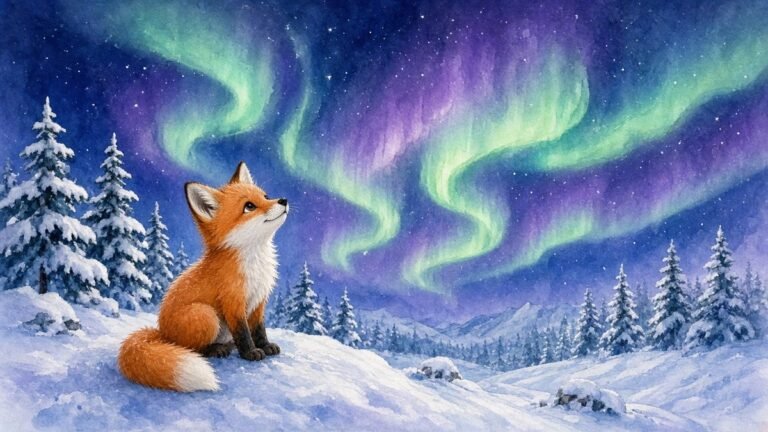
This bedtime story takes place in Alaska, under the northern lights. It is about a young fox who wants something that can’t be caught, and what he finds instead. It takes about six minutes.
A white fox in a white world
Far up in northern Alaska, where winter nights last almost all day, there lived a young arctic fox named Kit. In winter his fur was as white as the snow, so white that when he curled up on a snowbank, you could not see him at all, except for his black nose and two dark eyes.
Kit lived in a den under a hill with his mother. Every day, when the sun peeked over the edge of the world for a few short hours, they hunted for lemmings under the snow. Then the long night came again, and they curled up together to keep warm.
The night the sky danced
One night, Kit woke up and saw a strange light coming through the den’s opening. It was green. Not the green of summer grass, but a glowing, swirling green.
He crept outside and looked up. His mouth fell open.
Across the whole sky, ribbons of green light were waving and rippling, like curtains blowing in a breeze. At the edges they turned pink and purple. They moved slowly, then quickly, then slowly again, as if the sky were dancing to music Kit couldn’t hear.
“Mama!” he called. “The sky is on fire!”
His mother came out and sat beside him in the snow. “That’s not fire,” she said. “Those are the northern lights. People call them the aurora.”
“I want one,” said Kit. “I want to catch a ribbon and bring it into the den. Then we’ll have light all winter.”
His mother smiled. “You can try,” she said.
Chasing the lights
Kit ran. He ran across the frozen tundra, toward the place where the green ribbon seemed to touch the ground. His paws made tiny prints in the snow.
He ran past a snowy owl sitting on a rock. “Where are you going so fast?” asked the owl.
“To catch the northern lights!”
The owl blinked slowly. “Good luck,” she said, in a voice that meant she didn’t think he would have any.
Kit ran past a herd of caribou, their breath puffing in clouds. He ran up a hill and down the other side. But no matter how far he ran, the lights were always far ahead, still dancing at the edge of the sky.
At last, Kit stopped, panting. He was on the shore of a frozen lake. And he could go no farther.
The lake
Kit sat down, sad and tired. “I can’t catch them,” he whispered. “They’re too far away.”
He looked down at the lake. The ice was smooth and clear, like a mirror. And in it, he saw something wonderful.
The northern lights. Green and pink and purple, swirling right there under his paws. They were reflected in the ice, dancing beneath him just as they danced above.
Kit gasped. He lay down on the ice and put his nose right against it. The lights rippled around his face. He felt like he was floating in the middle of the sky.
“I didn’t catch them,” he said softly. “But they’re all around me.”
Home
Kit’s mother found him there a little later, lying on the ice with his eyes half closed.
“Did you catch one?” she asked gently.
“No,” said Kit. “But I found the best place to watch them. They’re up there and down here at the same time.”
His mother lay down beside him. Together they watched the lights swirl above and below. The night was cold and very still. The only sounds were the creak of the ice and their own soft breathing.
After a while, Kit’s mother carried him home in her mouth, the way she did when he was a tiny kit. She tucked him into the den and curled her bushy tail over him like a blanket.
Through the den opening, a little green light still glowed. Kit watched it until his eyes closed. And when he dreamed, he dreamed in green and pink and purple.
Talk about it
- Why couldn’t Kit catch the northern lights?
- Where did he find them in the end?
- What is the most beautiful thing you’ve seen in the sky?
- Are there things we can enjoy without owning them?
What are the northern lights?
The northern lights, or aurora borealis, happen when tiny particles from the Sun crash into gases high in Earth’s air. The gases glow, a bit like a neon sign. Oxygen makes green and red light, and nitrogen can make blue and purple. In the United States, Fairbanks, Alaska is one of the best places to see them, mostly between late August and April.

Read next


 Story break? Play one of 1,458 free kid-safe gamesPlay now →